Wondering when do cats stop growing? See the exact age range by breed and sex, plus how to tell your kitten has reached full size.
When do Cats Stop Growing?
If your kitten has gone from fitting in one hand to sprawling across half the couch, you’re probably wondering when do cats stop growing. Most house cats reach their adult size somewhere between 12 and 18 months old, but that range hides a lot of variation. A female domestic shorthair might be done filling out by her first birthday, while a Maine Coon kitten can keep growing well into his third year.
Here at Cats Care, this is one of the questions new kitten owners ask us most — usually while trying to figure out how much food to stock up on, what size carrier to buy, or when to switch off kitten formula. This guide walks through exactly when cats stop growing, what actually controls the timeline, and how to tell when your own cat has reached full size.
The Short Answer: When Do Cats Stop Growing?
Most cats stop growing between 12 and 18 months of age, once the growth plates in their bones close and skeletal development finishes. Female cats often finish earlier, around 10 to 12 months, while males and large breeds like Maine Coons and Ragdolls can keep growing until they’re two to four years old.
The Stages of Cat Growth
Growth doesn’t move in one steady line — it happens in distinct phases, and each one has its own pace. Understanding the stages makes it easier to tell whether your cat’s development is on track.
Birth to 6 Months: Rapid Kitten Growth
This is the fastest growth window of a cat’s life. Kittens gain weight quickly, and most of their bone length is laid down during these first six months. Feeding a kitten-specific formula matters most here, since the calorie and protein demands are significantly higher than for an adult cat.
6 to 12 Months: The Teenage Slowdown
Growth continues but at a noticeably slower pace, and most cats reach sexual maturity somewhere in this window, typically between 7 and 12 months. Your cat’s proportions start looking more adult, even though they’re still a way off from their final size, especially if they belong to a larger breed.
12 to 18 Months: Reaching Adult Size
This is when most cats settle into their adult height, length, and general frame. Growth plates in the long bones typically close during this stretch, which is the biological signal that skeletal growth is essentially finished for smaller and medium-sized breeds.
18 Months and Beyond: Filling Out
Even after skeletal growth wraps up, many cats keep gaining muscle mass and settling into their final body condition for several more months. Larger and slower-maturing breeds haven’t necessarily finished growing at all at this point some are barely halfway there.
Does Breed Affect When Cats Stop Growing?
Breed is one of the biggest factors in the timeline. Smaller breeds tend to finish early, while several large, long-haired breeds are famous for taking years rather than months. Here’s a rough comparison:
| Breed | Typical Age to Reach Full Size | Typical Adult Weight |
| Singapura | 9–15 months | 4–8 lbs |
| Domestic Shorthair (mixed breed) | 12–15 months | 8–12 lbs |
| Siamese | 12–15 months | 8–12 lbs |
| American Shorthair | 12–15 months | 8–12 lbs |
| Norwegian Forest Cat | 2–3 years | 9–16 lbs |
| Ragdoll | 3–4 years | 10–20 lbs |
| Maine Coon | 3–5 years | 10–20 lbs |
Figures above are general breed averages and will vary by individual cat, sex, and genetics — treat them as a planning guide rather than a guarantee. The pattern worth remembering: bigger-bodied breeds almost always take longer to finish growing, because more skeletal mass simply takes more time to build.
Male vs. Female Cats: Who Grows Longer?
Sex plays a real role in the timeline. Female cats tend to finish growing earlier, often by 10 to 12 months, while males commonly continue until closer to 18 months. Males also tend to end up somewhat larger overall, a pattern that holds across most breeds rather than being specific to one or two.
This isn’t a hard rule — an individual female Maine Coon will still out-grow an individual male Singapura by a wide margin. Sex shifts the timeline within a breed; breed still sets the outer limits.
Does Spaying or Neutering Affect Growth Timing?
It can, and the effect is counterintuitive: spaying or neutering tends to extend growth slightly rather than shorten it. Sex hormones help signal a cat’s growth plates to close, so removing that hormonal signal through an early spay or neuter can delay closure and stretch the growth window a bit longer than it would run in an intact cat.
This is one reason vets sometimes note that altered cats end up marginally larger-framed than intact littermates. It’s a minor effect next to breed and sex, but it explains why two cats from the same litter can finish growing at noticeably different ages.
How to Tell If Your Cat Has Stopped Growing
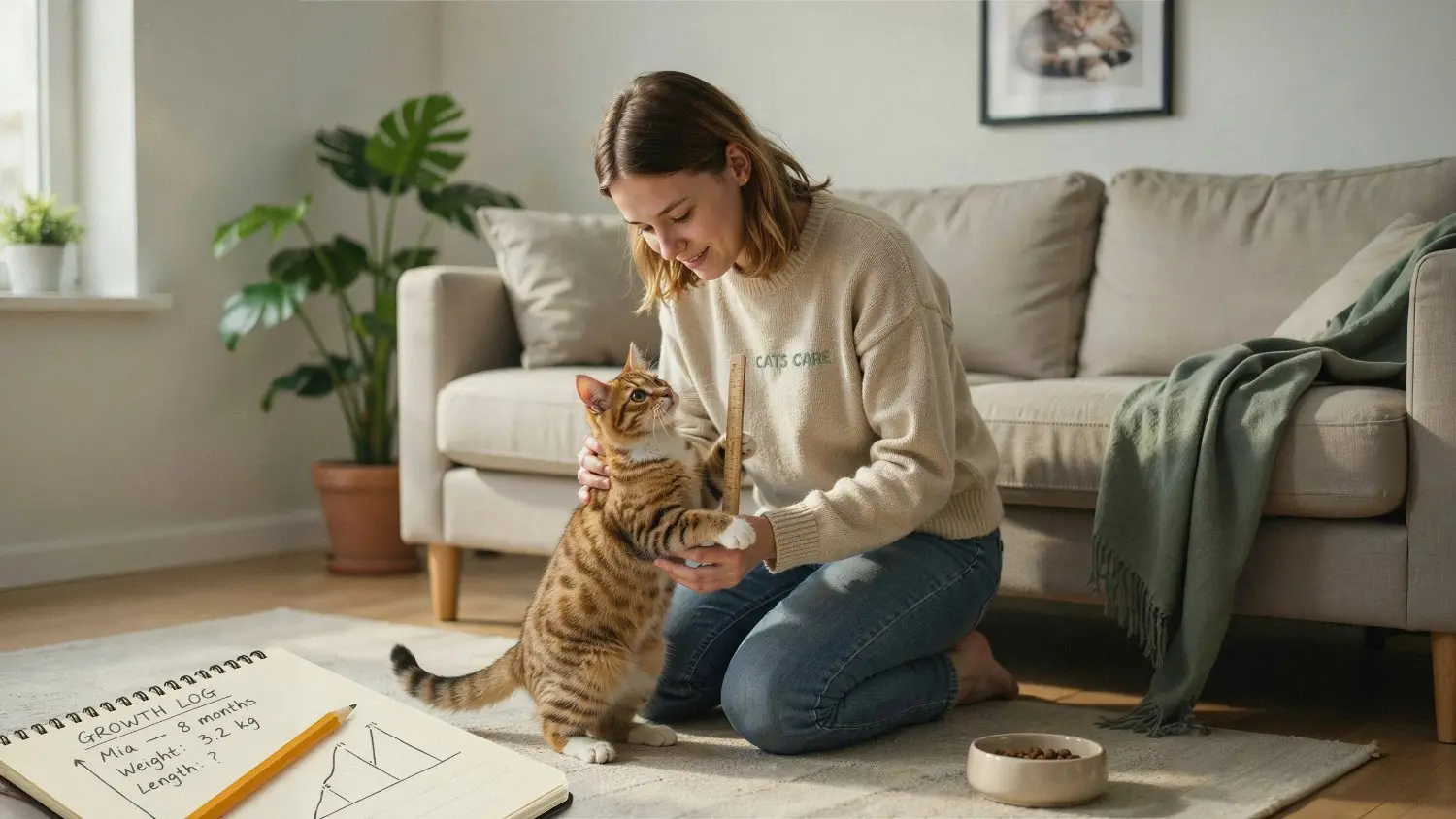
The most reliable method doesn’t require guesswork — it just takes a few weeks of consistent tracking:
- Weigh your cat every 2–4 weeks using a pet scale or a baby scale at home.
- Measure length (nose to the base of the tail) and height at the shoulder at the same intervals.
- Keep diet and activity level consistent while you track, so the numbers reflect growth rather than diet changes.
- Watch for the numbers to hold steady across two to three consecutive checks.
- Notice behavioral cues too — kitten-style hyperactive play typically settles into calmer adult patterns around the same time physical growth tapers off.
Once weight, length, and height have stayed essentially flat for a couple of months on a stable routine, you can be fairly confident your cat has reached full size. For large or purebred cats, your vet can also check growth plate closure directly during a routine exam if you want a more definitive answer.
Supporting Healthy Growth: Nutrition and Care Tips
Whatever stage your cat is in, nutrition is the biggest lever you actually control. Kitten formulas are calorie- and protein-dense to support rapid early growth, and most cats should stay on one until at least 12 months old — longer for large breeds that are still developing. Our kitten food guide walks through exactly when and how to transition to adult food without upsetting your cat’s stomach.
Routine vet checkups matter just as much as food. A vet can flag growth that’s tracking unusually slow or fast, confirm a healthy weight trajectory, and advise on the right timing for spaying or neutering for your specific cat. If you haven’t been in for a checkup recently, our new kitten checklist covers what to bring up at the visit.
The Bottom Line
There’s no single answer to when do cats stop growing — but there’s a reliable pattern. Most cats finish growing by 12 to 18 months, females tend to finish earlier than males, and large breeds like Maine Coons and Ragdolls can keep developing for years. The most trustworthy way to know for certain is to track your own cat’s weight and measurements over time rather than relying on age alone.
Curious whether your kitten’s growth is on track for their breed? Explore our Kitten Growth & Nutrition Guide for age-by-age feeding advice, or subscribe to the Cats Care newsletter for care tips timed to your cat’s exact stage.
Frequently Asked Questions
What age is a cat considered fully grown?
Most cats are considered fully grown between 12 and 18 months old, once their growth plates close and their skeleton stops lengthening.
That 12–18 month window covers height, body length, and skeletal structure. Weight and muscle tone can keep changing a little longer, especially in males and larger breeds, but by 18 months the vast majority of cats have the frame they’ll keep for life.
Do all cats stop growing at the same age?
No — breed, sex, and spay/neuter status all shift the timeline, sometimes by years.
A Singapura can be full-grown by 9 months, while a Maine Coon may not finish filling out until age 3 to 5. Females typically finish earlier than males, and spayed or neutered cats often keep growing slightly longer than intact cats of the same breed.
Why is my 1-year-old cat still growing?
That’s normal for many cats — 12 months is closer to the start of the finish line than the end for a lot of breeds.
If your cat is male, a larger breed, or was spayed/neutered, continued growth at 12 months is expected rather than unusual. Keep feeding a kitten or growth-formula diet until your vet confirms your cat has reached adult size.
Does neutering stop a cat from growing?
Neutering doesn’t stop growth — it can actually extend it slightly by delaying growth plate closure.
Sex hormones help signal growth plates to close. Removing that hormonal signal through spaying or neutering can push the closing date back, which is one reason many vets note that altered cats sometimes grow a bit longer and end up marginally larger-framed than intact cats of the same breed.
How can I tell if my kitten has reached full size?
Weigh and measure your cat every few weeks — once the numbers hold steady for two to three consecutive months, growth has essentially finished.
Look for the same weight, body length (nose to base of tail), and height at the shoulder across several checks, combined with a consistent diet and activity level. A vet visit can confirm growth plate closure if you want a definitive answer, particularly for large or purebred cats.
Most cats are considered fully grown between 12 and 18 months old, once their growth plates close and their skeleton stops lengthening.
That 12–18 month window covers height, body length, and skeletal structure. Weight and muscle tone can keep changing a little longer, especially in males and larger breeds, but by 18 months the vast majority of cats have the frame they’ll keep for life.
No — breed, sex, and spay/neuter status all shift the timeline, sometimes by years.
A Singapura can be full-grown by 9 months, while a Maine Coon may not finish filling out until age 3 to 5. Females typically finish earlier than males, and spayed or neutered cats often keep growing slightly longer than intact cats of the same breed.
That’s normal for many cats — 12 months is closer to the start of the finish line than the end for a lot of breeds.
If your cat is male, a larger breed, or was spayed/neutered, continued growth at 12 months is expected rather than unusual. Keep feeding a kitten or growth-formula diet until your vet confirms your cat has reached adult size.
Neutering doesn’t stop growth — it can actually extend it slightly by delaying growth plate closure.
Sex hormones help signal growth plates to close. Removing that hormonal signal through spaying or neutering can push the closing date back, which is one reason many vets note that altered cats sometimes grow a bit longer and end up marginally larger-framed than intact cats of the same breed.
Weigh and measure your cat every few weeks — once the numbers hold steady for two to three consecutive months, growth has essentially finished.
Look for the same weight, body length (nose to base of tail), and height at the shoulder across several checks, combined with a consistent diet and activity level. A vet visit can confirm growth plate closure if you want a definitive answer, particularly for large or purebred cats.
Hi, I’m Sana Sajid!I’m the voice behind CatsCare.blog, sharing my 10+ years of hands-on cat care experience. With a diploma in animal care, I offer practical tips, trusted advice, and easy-to-follow guides to help keep your cats healthy and happy.
When I’m not writing, I spend time with my own cats or exploring the latest developments in feline health. Follow CatsCare.blog for expert insights and real cat stories!
![A beautiful tabby cat with amber eyes sitting with its paw up, used to illustrate content discussing the reasons for feline salivation and answering [Why do Cats Drool].](https://catscare.blog/wp-content/uploads/2025/12/Why-do-Cats-Drool.jpg)