
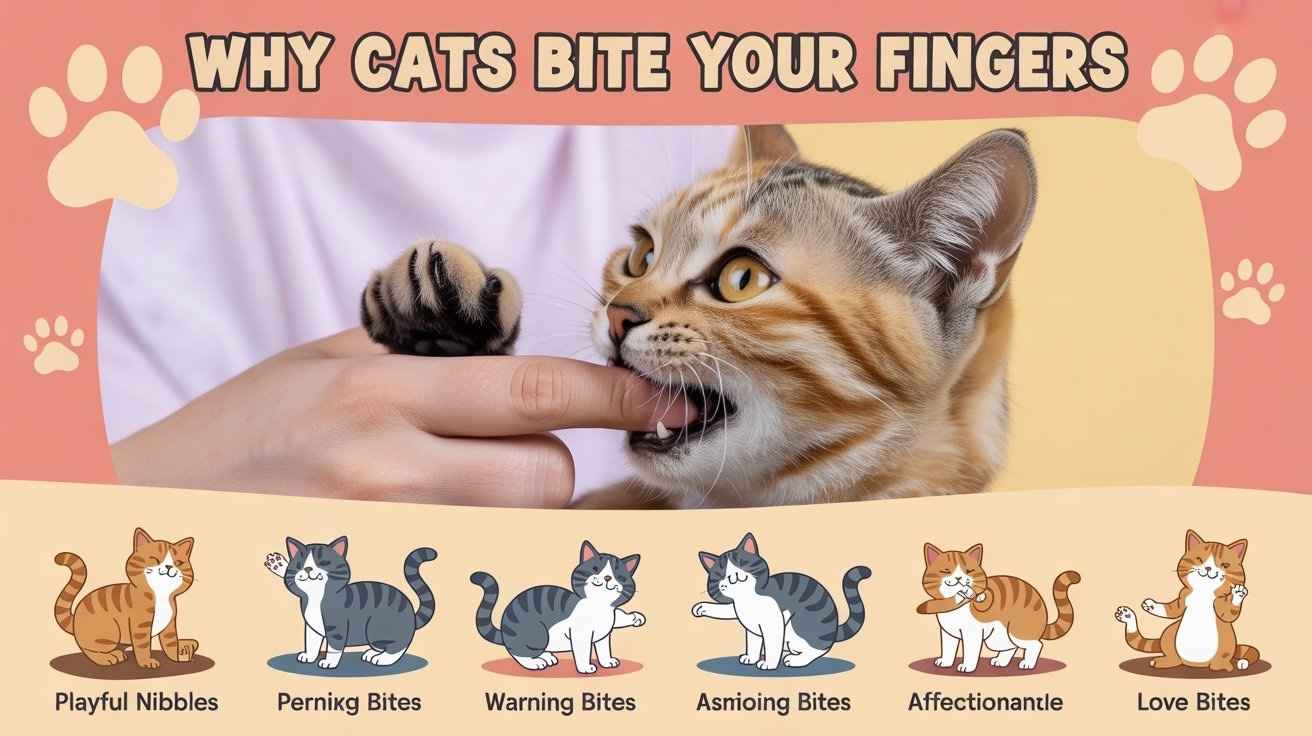
Why cats bite your fingers: 1. Playful instinct 2. Overstimulation 3. Teething 4. Attention 5. Affection 6. Stress.
Why Cats Bite Your Fingers
If your cat loves to bite your fingers, you’re definitely not alone.
Many cat owners experience this curious mix of affection and attitude.
Sometimes these bites are playful, sometimes they’re a warning, and other times they’re just your cat’s unique way of saying, “I love you — but stop moving your hand.”
Cats use their mouths as communication tools — to express emotion, mark territory, or play.
Let’s break down the six most common reasons your cat might be turning your fingers into a chew toy.
Quick Look: Why Cats Bite Your Fingers
| Reason | Behavior Type | Meaning Behind It |
|---|---|---|
| Playful Instinct | Gentle nibbling during play | Mimics hunting and fun behavior |
| Overstimulation | Sudden bite while petting | Too much touch triggers a reflex |
| Attention-Seeking | Soft bites to get noticed | Wants playtime or affection |
| Love Bites | Gentle, slow nips | Shows trust and bonding |
| Teething (Kittens) | Constant chewing on fingers | Soothes growing teeth |
| Territory or Dominance | Firm, warning bites | Asserting control or space |
1. Playful Instincts Take Over
Cats are born hunters, and your wiggling fingers look like the perfect target.
When your cat bites gently during play, it’s not aggression — it’s instinct.
In the wild, cats stalk, chase, and pounce. When they play with you, they’re recreating that hunt in a safe way.
If the bites are soft and followed by purring or light pawing, it’s just their way of having fun.
Tip: Use toys like feather wands or string teasers to redirect that playful biting away from your hands.
2. Overstimulation While Petting
Has your cat ever purred happily, then suddenly bit you mid-pet?
That’s called petting-induced overstimulation.
Cats enjoy touch — but only to a certain point. Too much stroking overstimulates their skin and nerves, leading to a quick bite as a reflex.
It’s not anger; it’s simply their way of saying, “Okay, that’s enough for now.”
Watch for warning signs: tail twitching, flattened ears, or tense muscles — these mean your cat’s done with cuddles.
3. Seeking Attention
Cats are clever and know how to get what they want.
If you’re busy on your phone or laptop, your cat might give a light bite to demand attention.
These bites are soft, quick, and often followed by a stare — as if to say, “Hey, I’m right here!”
It’s their playful way of reminding you who’s really in charge of your schedule.
Fix it: Give them short play sessions or interactive toys to burn energy and reduce attention-seeking nips.
4. Love Bites Are Real
Not all bites are bad — some are actually signs of affection.
When your cat gives you gentle, slow nibbles during cuddle time, they’re expressing comfort and trust.
In cat behavior, grooming and nibbling often go hand-in-hand. It’s how cats bond with those they feel safe around — including you.
These “love bites” are your cat’s version of saying “you’re mine.”
Note: If the bites get harder, it might shift from affection to overstimulation — take it as your cue to stop petting.
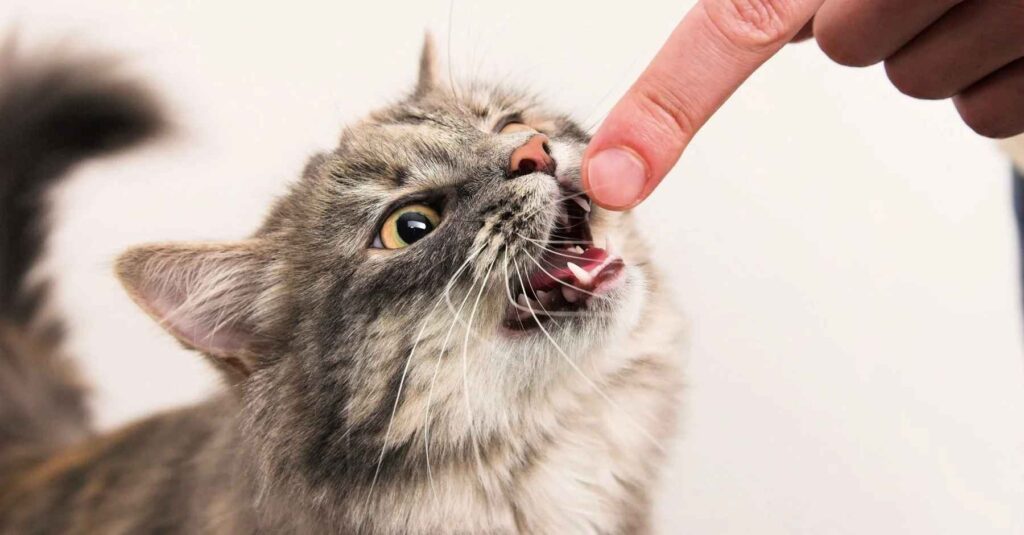
5. Kittens and Teething
If you’ve got a kitten, finger biting is practically guaranteed.
When their teeth start growing, it causes soreness and irritation — and your fingers become the perfect chew toy.
Chewing helps relieve discomfort and also teaches bite strength control.
It’s part of normal kitten development, not bad behavior.
Fix it: Offer safe teething toys or frozen washcloths so they can chew safely instead of using your fingers.
6. Asserting Territory or Dominance
When a cat gives a firm or warning bite, followed by a fixed stare or low growl, it’s about control or space.
They may be asserting dominance, guarding a resource, or simply telling you to back off.
Cats value boundaries, and when they feel those are crossed, biting becomes a clear message.
Respect the signal and give them time to cool down — forcing contact will only stress them further.
Tip: Learn your cat’s cues — understanding body language helps prevent unwanted bites.
FAQs
Q1: How can I stop my cat from biting my fingers?
Redirect their attention to toys instead of hands. Avoid rough play that encourages finger biting.
Q2: Are finger bites a sign of aggression?
Not always. If your cat’s body is relaxed and purring, it’s playful. Flat ears and a stiff tail mean it’s time to stop.
Q3: Should I punish my cat for biting?
Never. Cats don’t understand punishment — it only increases fear or aggression. Use calm redirection and end play gently.
Q4: Why does my cat bite me gently, then lick me?
That’s a mix of affection and overstimulation — your cat loves you but is also telling you, “that’s enough.”
Q5: Do some cats bite more than others?
Yes. Young, energetic, or under-stimulated cats tend to bite more often. Regular playtime and enrichment can reduce this behavior.

Hi, I’m Sana Sajid!I’m the voice behind CatsCare.blog, sharing my 10+ years of hands-on cat care experience. With a diploma in animal care, I offer practical tips, trusted advice, and easy-to-follow guides to help keep your cats healthy and happy.
When I’m not writing, I spend time with my own cats or exploring the latest developments in feline health. Follow CatsCare.blog for expert insights and real cat stories!


![An illustration titled "WHY DO CATS IGNORE YOU." It features three cats—a tabby, an orange cat, and a black cat—with thought bubbles pointing to their behavior, labeled "INDEPENDENCE MODE," "FELINE MODE," and "FELINE COMMUNICATION." The graphic explains the reasons [Why Do Cats Ignore You] with a human hand reaching out on the right.](https://catscare.blog/wp-content/uploads/2025/11/Why-Do-Cats-Ignore-You.jpg)
One thought on “6 Surprising Reasons Why Cats Bite Your Fingers”